Spirou Et Fantasio Tome 53 Pdf Writer
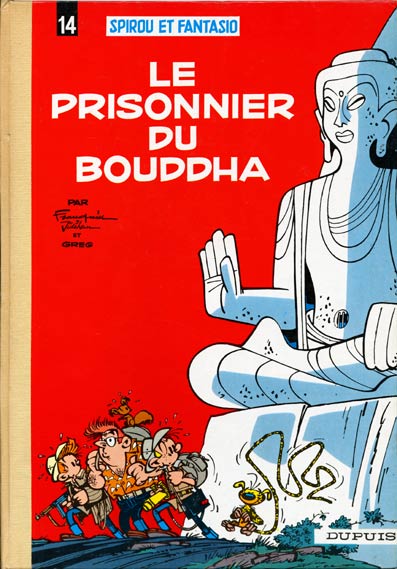
Gaston's first cameo in a Spirou et Fantasio. Jean-Claude Fournier succeeded Franquin as artist and writer of the Spirou and Fantasio. When Tome and Janry took.
- Fantasio Spirou Pdf
- Fairy Tail Tome 53
- Spirou Et Fantasio Tv Show
- Spirou Et Fantasio Tome 53 Pdf Writer Download
- Spirou And Fantasio
PDF Spirou Et Fantasio Tome 12 Le Nid Des Marsupilamis this pdf of Spirou Et Fantasio Tome 54 Le Groom De Sniper Alley It takes me 75 hours just to get the right download link, and another 8 hours to validate it. Spirou et Fantasio 53 Tomes Spirou et Fantasio 53 Tomes UPLOADED Spirou. De Capes et de Crocs bd ddl, download ddl, download. Black Op - saison 1 - Tome 1 PDF Online. 2: Le Plus dur est la chute PDF Kindle. 3: Harbinger Wars PDF Kindle. Spirou et fantasio tome 15 z comme zorglub [PDF] spirou et fantasio tome 15 z comme zorglub Download spirou et fantasio tome 15 z comme zorglub in EPUB Format. All Access to spirou et fantasio tome 15 z comme zorglub PDF or Read spirou et fantasio tome 15 z comme zorglub on The Most Popular Online PDFLAB. Spirou Et Fantasio Tome 53 Pdf Free there. The sheer energy of De La Pava’s sentences, his eye for absurd humor, his commitment to the idea of justice- -all will be familiar here as they carry us from the tale of an obsessive, damaged psychic detective consumed by a murder case, into a Sartrean drama that raises questions (and jokes) about. Free download spirou et fantasio tome 19 pdf book spirou et fantasio tome 19 download ebook spirou et fantasio tome 19 pdf ebook spirou et fantasio tome 19 Size 59,79MB Spirou Et Fantasio Tome 19 Epub Download Scanning for Spirou Et Fantasio Tome 19 Do you really need this respository of Spirou Et Fantasio Tome 19 It takes me 23 hours just to.
| Belgian comics | |
|---|---|
Tintin and Snowy (Hergé), on the roof of the former headquarters of Le Lombard near Brussels-South railway station | |
| Earliest publications | Late 1920s |
| Publishers | |
| Creators | |
| Series and characters | |
| Languages | |
| Related articles | |
| Dutch comics Franco-Belgian comics European comics | |
| Comics |
|---|
| Comics studies |
|
| Methods |
| Media Formats |
| Comics by Country and Culture |
|
| Community |
Belgian comics are a distinct subgroup in the comics history, and played a major role in the development of European comics,[1] alongside France with whom they share a long common history. While the comics in the two major language groups and regions of Belgium (Flanders with the Dutch language and Wallonia with French) each have clearly distinct characteristics, they are constantly influencing one another, and meeting each other in Brussels and in the bilingual publication tradition of the major editors.[2] As one of the few arts where Belgium has had an international and enduring impact in the 20th century, comics are known to be 'an integral part of Belgian culture'.[3]
- 1History
- 2Importance
History[edit]
Before 1940[edit]
The first large-scale production of comics in Belgium started in the second half of the 1920s. Earlier, illustrated youth pages were still very similar to the Images d'Épinal and the Flemish equivalent, the Mannekensbladen.[4] The comics that were available came from France and were mostly available in parts of Belgium where the French language dominated (Wallonia and Brussels). The most popular were La Semaine de Suzette, L'Épatant and Le bon point illustré.[5] French authors like Marijac contributed to Belgian magazines as well.[6]
The 1920s saw the formation of many new youth magazines, some independent like the bilingual Zonneland / Petits Belges from Catholic publishers Altiora Averbode or scout magazines like Le Boy-Scout Belge, where Hergé (Georges Remi) debuted; others were published as newspaper supplements. The most famous of these was Le Petit Vingtième, the weekly youth supplement to the Catholic newspaper Le Vingtième Siècle. Founded in 1928, it employed the young artist Georges Remi as editor-in-chief and main contributor. Remi, better known as Hergé, launched in January 1929 a new series for the supplement: The Adventures of Tintin. Initially heavily influenced by the work of French comics authors Alain Saint-Ogan and Pinchon[7] and the American George McManus,[6] Hergé soon developed his own style. Tintin soon became very popular, and sales of the newspaper quadrupled on Thursdays, when the supplement was included.[8] It would become the prototype for many Belgian comics to come, in style (the so-called ligne claire), appearance rhythm (weekly), use of speech balloons (whereas comics from other countries like the Netherlands and Denmark would keep the text beneath the drawings for decades to come), and the method of using a first appearance in a magazine or newspaper and subsequent albums.[9]
While Tintin was very popular, it would take almost a decade before the next successful comics magazine would appear. In the meantime, an increasing number of youth magazines would publish some pages with comics influenced by Tintin.
George Van Raemdonck, the first major Flemish comics artist, worked almost exclusively in the Netherlands until after World War II. Still, he influenced some of the earliest pre-war Flemish artists like Jan Waterschoot and Buth, and as a newspaper artist with a daily comic strip, he paved the way for the typical publishing method of the Flemish comics when compared to the prevalent Walloon magazine publications.[10]
More situated in the classic arts than in the mainstream comics publishing was Frans Masereel, a Flemish wood engraver whose 1926 'Passionate Journey', a wordless story told in 165 woodcuts, is sometimes considered as the first graphic novel.[11]
In the second half of the 1930s, most Walloon youth magazines made room for one or more comics by local artists. Examples are Jijé in Le Croisé in 1936 and in Petits Belges in 1939, François Gianolla in Jeunesse Ouvrière, and Sirius in Le Patriote Illustré.[12]Dupuis, a publisher based in Marcinelle near Charleroi, was already having success with its two family magazines Le Moustique and Bonnes Soirées. Charles Dupuis, son of the CEO, decided to start a youth magazine centred around a new hero, Spirou.[13] It debuted on April 21, 1938.[14] French artist Robert Velter, a former assistant of Martin Branner,[14] was asked to create the title series, and the rest of the magazine was filled with popular American comics such as Superman. 8 months later, in an unusual move, the magazine was published in Dutch under the name Robbedoes. This would have a profound influence on the development of the Flemish comics and assured that Belgian comics would have a large part of their development in common. In 1939, Jijé joined the magazine. He worked there until his death in 1980, and was the driving force of the magazine during and directly after the war. He was responsible for its expansion and success in the next decades, and was as the inspirator for the later generation of comics artists in the 1940s and 1950s which is known as the Marcinelle school.[15] Apart from Hergé, Jijé's main inspiration came from American artists such as Milton Caniff and Noel Sickles.[14]
Some Flemish magazines started producing more modern local comics as well, with works by established artists like Frans Van Immerseel in Zonneland and the expressionist painter Frits Van den Berghe in Bravo, or new names like Jan Waterschoot in Zonneland or Eugeen Hermans (aka Pink) in Ons Volkske, a weekly newspaper supplement inspired by Le Petit Vingtième. The most important comics writer for Bravo and Zonneland was John Flanders, who would continue to provide stories for the Flemish magazines until the 1960s.[16]
World War II[edit]
During the war, many magazines had to stop publication or scale back their activities due to paper shortage and the limitations imposed by the German occupiers.[14]Le Petit Vingtième was dissolved after the German invasion, and Hergé started working for the collaborating newspaper Le Soir, where he had to change from a weekly double page of Tintin to a daily strip. Paper shortage also forced him to reduce the number of pages per album from the previous 120 to 62. To compensate for this, the editor Casterman decided to start publishing the albums in colour instead of black and white.[17] This became the post-war standard for all albums by the Walloon and Brussels publishers: From the 1960s on, almost all Flemish comics have been printed in colour.
Other magazines tried to continue publication, but had to replace the forbidden American comics with local material. This was an opportunity for new talent to emerge. In Spirou, Jijé was joined by Sirius and the young illustrator Maurice Tillieux.[18]
The Flemish magazine Bravo, started in 1936 with almost exclusively American comics, had to change course in 1940, and created a French-language version as well, attracting a number of young Belgian artists like Edgar P. Jacobs, Jacques Laudy, Raymond Reding and the Flemish Willy Vandersteen, together with the already well-known illustrator Jean Dratz.[19]
Another way out for young artists were a number of small animation studios, created when the popular American animated movies of the 1930s might no longer be shown. In Antwerp, Ray Goossens and Bob de Moor started with AFIM, and in Brussels, André Franquin, Eddy Paape, Peyo and Morris worked for CBA.[20]
1944–1958[edit]
The end of World War II was a second caesure, with again many magazines disappearing or changing hands, while a huge amount of new magazines appeared now that censure and paper shortage were coming to an end. Spirou, which had disappeared at the end of 1943, reappeared in 1944 with the same authors. Bravo on the other hand got new owners, and the main contributors searched new publishers. The newspaper Le Soir replaced its wartime version and all the staff with the pre-wartime owners and staff, and Hergé was left without a publication outlet for nearly two years while allegations of collaboration with the Germans were investigated.
In 1946, Raymond Leblanc wanted to start a youth magazine to expand his small publishing house Lombard, and decided to use the already very popular Tintin as the main hero for Tintin magazine. It started in 1946 with a French and Dutch language version (the latter called Kuifje), as had become the custom for Belgian comics magazines. A version for France followed in 1948. The magazine immediately employed mainly Belgian artists, most coming from Bravo: Jacobs (who already had collaborated with Hergé), Laudy, and the young debutant Paul Cuvelier. It was an instant success, and soon other names joined, including Jacques Martin. To get the same success with the Flemish version (where Tintin was not so well known yet), two of the best new Flemish artists were contacted: Bob de Moor and Willy Vandersteen.[21] De Moor stayed with Hergé and Tintin until the end of his life, but Vandersteen left the magazine again after 11 years.[22]
Many other magazines only survived for a few years, and their best artists then joined either Spirou or Tintin. Magazines like Bimbo, Story or Wrill mainly had regional success and lacked a truly popular main series.[23] Tillieux worked for Bimbo, Martin for Wrill, André-Paul Duchâteau started his writing career in the new version of Bravo. Petits Belges / Zonneland continued to be published, but only devoted a few pages to comics. The main artist in these days is Renaat Demoen, later joined by François Craenhals.
The main competitor for Tintin and Spirou in this period was Heroic-Albums, which had a different publishing method: instead of a number of continuing stories which often appeared continuously with a rhythm of one page a week, Heroic published one complete long story every week. The main artists were Tillieux, Fred Funcken, Tibet, François Craenhals, Greg, ..[24] Due to being censored in France, the magazine finally disappeared in 1956.
In Flanders, there was a similar boom of new magazines, but the most important artists and comics in the long run worked mainly for the newspapers: Marc Sleen filled many pages in the magazine 't Kapoentje, but his main series Nero appeared in the newspaper Het Volk from 1947 on. Willy Vandersteen worked for a whole series of magazines, both in Dutch and French, but his main series Spike and Suzy appeared in De Standaard from 1945 on.
These two artists dominated the Flemish comics scene until 1980,[25] but even though Nero gets translated in French and German, the only success outside Flanders was Spike and Suzy, which became the most popular comic of the Netherlands and got a sizable audience in Wallonia as well, mainly because of the appearance of seven specially created stories in Tintin, which are commonly considered to be the best of the series.[22] Due to this success, Vandersteen opened a Studio which produced hundreds of comics and gave many young local artists a steady job. However, contrary to the School of Marcinelle and to a lesser degree the Studios Hergé, very few artists had a successful independent career after leaving the studio. One of the major series of the Studio was Bessy, originally made for the Walloon newspaper La Libre Belgique in 1952, and which would only later find its way to Flanders and finally to a series of more than 1000 comic books in Germany.[26]
Meanwhile, many artists who would later become famous debuted on a small scale in the Walloon newspapers: Peyo, Greg, Albert Uderzo, René Goscinny, ..[27]
In the 1950s, the comics scene in Belgium is dominated by three main publishing methods: the main magazines Tintin and Spirou, coupled with the albums published afterwards by the editors Lombard and Dupuis; the daily newspaper comics in Flanders, with the cheaper black and white albums afterwards by De Standaard and Het Volk: and the weekly newspaper supplements of the French language newspapers, which mainly lacked subsequent albums. The number of other magazines slowly decreased, and the independent comic albums publishers without a magazine disappeared with the exception of Casterman, publisher of the comics by Hergé and a limited number of other comics.
In this period, the Belgian comics had their Golden Age, a period of constant growth and expansion, with the start and continuation of many of the most popular Belgian series.
Spirou expanded from 12 pages of newspaper quality to 52 full colour pages, and the number of American comics, reintroduced after the end of the war, dwindled to near nil in 1950. Their place was taken by Victor Hubinon and Jean-Michel Charlier (Buck Danny), Maurice Tillieux (Gil Jourdan), Eddy Paape, Will, and most importantly André Franquin, Morris, and Peyo. Their respective series Gaston Lagaffe, Lucky Luke and The Smurfs became international bestsellers. While the first generation learned much of the art while working with Jijé, many younger artists started their professional career in the Studio Peyo before creating their own series, assuring the continuation of the School of Marcinelle. The humour aspect of the magazine was assured by the editor-in-chief Yvan Delporte, writer for Franquin, Will and Peyo.[28] Together with the main artists of Tintin, they defined the Franco-Belgian comics for decades to come.
Tintin had a similar story, with rapid success and expansion. New artists like Jean Graton (Michel Vaillant) and Raymond Macherot reached new audiences. Hergé started his Studio to help him with the work on the Tintin comics, and it defined the style of many artists like Bob de Moor and Roger Leloup.
The styles of the two magazines were distinctly different, with the ligne claire and the more serious, didactic tone of Tintin contrasting with the humorous, more caricatural Marcinelle school of Spirou.
In Flanders, no local magazine could equal the success of the two translated Walloon magazines, and to survive this period, they disappeared as independent magazines and became weekly newspaper supplements. The most important was 't Kapoentje, which published the work of Buth and Rik Clément, but which had no influence outside Flanders. The only new artist to become truly successful in this period was Jef Nys with Jommeke, which debuted in 1955 and became the third major daily newspaper comic in Flanders.[29]
Artists like Pom, Bob Mau or Renaat Demoen were less successful and had only a limited audience, while other Flemish artists started working for the French language magazines, following in the footsteps of Morris in Spirou and Bob de Moor in Tintin. The most successful of those in this period was Berck, who first appeared in this period in Tintin before moving to Spirou.
1959–1977[edit]
From 1959 on, the dominance of Spirou and Tintin slowly disappeared. The first generation of artists could not continue the publication rhythm of the previous decades, and French magazines reached new audiences, helped by the protectionistic censoring by the French authorities. French artists like René Goscinny and Albert Uderzo, who previously worked for Belgian magazines and newspapers, started their own magazine Pilote, and the less restrictive atmosphere there attracted some of their main colleagues from Spirou like Morris, Jijé, Charlier and Hubinon. Apart from Morris, they all continued working for Spirou as well, but the decline had started.
Tintin suffered from the lack of new stories by Hergé. Greg became the new editor-in-chief in 1962 and stayed on until 1975, introducing a new, more adult style and content to the magazine, and introducing some major new artists like Hermann Huppen, William Vance, Jean Van Hamme and Dany. But despite the critical acclaim of these authors, the circulation slowly declined from the record high of 270,000 copies a week in France alone, and the different international editions of Tintin disappeared over the next decade, but not before launching a last major series with Thorgal by Rosinski.[30]
Spirou as well had to introduce new artists and series to fill the pages and keep their readers. It took many of them until around 1970 to become real stars, with the rise of Raoul Cauvin as the new main writer of the magazine. The biggest new series of the 1960s was Boule et Bill by Franquin-collaborator Jean Roba. It became the most popular series of the magazine together with Gaston Lagaffe after the disappearance of Lucky Luke in 1967. Around 1970, Berck (Sammy), Lambil (Les Tuniques Bleues), François Walthéry (Natacha), and Leloup (Yoko Tsuno) were the main new artists and series,[31] with Raoul Cauvin as the most important writer.[32] However, the top circulation of about 280,000 copies a week (France and Belgium combined), was no longer reached after 1966.[32]
In Flanders, the situation was very stable, with the limited local publication possibilities all taken by the established authors of the 1940s and 1950s, leaving no room for new talents after the disappearance of most magazines. New artists either started working in the large Studio Vandersteen or tried to get into Spirou and Tintin, thereby strengthening the bond between the comics scenes of both language groups.
Comics fandom, started in the Netherlands and France in the 1960s, emerged in Flanders in 1966 with the different publications by Jan Smet, who also created the first Flemish comics award in 1972. This developed into the Bronzen Adhemar, the most important comics award of Flanders, named after the child prodigy character Adhemar in The Adventures of Nero.[33] In Wallonia, it only seriously commenced in 1971, with the first awards (the Prix Saint-Michel in Brussels) and fanzine (Rantanplan), both by André Leborgne, and the first specialized shop and republisher of old material, Michel Deligne. The Institut Saint-Luc in Brussels created a comics department with teachers like Eddy Paape, and was largely responsible for the new, more adult-oriented authors who came to the fore in the 1980s and 1990s. Expositions with the major artists were organized throughout the country, some by amateur enthusiasts, some endorsed by the government.[34]
1978–present[edit]
The last decades have shown the further decline of the traditional publication systems of the Belgian comics, and the end of the dominance of the Belgian authors in European comics.
Reflecting the shift from the dominance of weekly youth comics to longer adult comics was the demise of Tintin and the start of A Suivre in 1978, the more adult oriented monthly magazine of publisher Casterman.[35] It published longer 'chapters' of the main European authors of graphic novels, with artists like Hugo Pratt and Jacques Tardi. Among them, room was still reserved for the best Walloon and Brussels' talents, including Didier Comès, Benoît Sokal, and François Schuiten. The magazine, seen as the more intellectual reply to French magazines like Métal Hurlant who were more oriented towards graphical innovation, was a big success and had a lot of influence, but turned out to be relatively short-lived. The Dutch language edition, started in 1980, folded in 1989 (the same year Poilote ceased publication), and in 1997 the French language edition disappeared as well, further demonstrating the demise of the magazine format in a market where most people prefer to immediately buy the albums.[36]
In Flanders, a final experiment with a youth comics magazine was started in 1993 with Suske en Wiske Weekblad by Standaard Uitgeverij: with a mix of classic comics and new series and carried by the most popular Dutch language series and a sizable promotional campaign, it got a sizable audience at first, but slowly lost momentum and disappeared in 2003.
The only comics magazine to survive is Spirou, but with the end of the Dutch version Robbedoes in 2005, when the circulation had dropped to only about 3,000 copies, no mass-market comics magazines for the Flemish audience remained, making it harder for young Flemish artists to gain a larger audience.
Spirou, meanwhile, after a decline during the 1970s and 1980s from 280,000 to 160,000 copies, holds on to a quite steady circulation, and is a mix of a showcase for Dupuis and a method to test new artists and series before doing the sizable investment of an album series. After experiments to target a more mature audience in the late 1970s and in the 1980s with the supplement Le Trombone Illustré and the publication of comics like XIII and Jeremiah, the focus is again fixed on humour series and an audience of young teenagers. Now famous artists like Bernard Hislaire, Zep, Tome, Janry or Midam debut or still publish in the magazine.
But next to the magazine, Dupuis, like all the other editors, targets the older audience as well with a collection of graphic novels.
Both Lombard and Dupuis have since been bought by the French media concern Média Participations, but retain a large degree of independence.
In Flanders, this period started with the appearance of two new successful newspaper comics, Bakelandt by Hec Leemans and the extremely successful Kiekeboe by Merho.[37] But they seemed to be at the same time the final successes of a slowly dying system, and comics in Flanders are more and more centered around albums as well. Successful series and authors are few and far between, and most, like Urbanus or F. C. De Kampioenen, are only a local success. A few peripheral figures like Ever Meulen, who is mainly an illustrator, or Kamagurka, who is more of a cartoonist, do become successful in Wallonia, France and the Netherlands,[38] but apart from those exceptions, the main method for Flemish comics artists to become successful is still being published by the three French language publishers.
Some of the most successful of these since the 1960s are William Vance, Jo-El Azara, Griffo, Marvano, Jean-Pol, Jan Bosschaert and Luc Cromheecke.[39]
Importance[edit]
Sales[edit]
While until 1930 almost all comics published in Belgium were either French or American, due to the success of Tintin in 1950 almost no foreign comics are published in Belgium anymore, and by 1960 many or even most comics read in other Western European countries (excluding the United Kingdom) are made by Belgians or for Belgian magazines. By 1944, 275,000 albums of Tintin had been sold:[40] by 2000, the worldwide sales had multiplied to nearly 200 million.[41]
In 2000, almost 40 million albums were printed in Belgium each year: 75% of those were exported. An estimated 75% of the comics sold in France were made by the three large Belgian comics publishers, Dupuis, Le Lombard and Casterman. Dupuis alone, with a production of 9 to 10 million albums a year and a back catalogue of 1,000 titles, is responsible for one third of the French comics market.[41] The Flemish market is largely monopolized by the giant Standaard Uitgeverij, whose Spike and Suzy are produced with 300,000 to 400,000 copies for each new title, half of which are exported to the Netherlands, and who also publishes Nero, Kiekeboe and Urbanus. Het Volk, who largely existed due to one title, Jommeke, with a total sales of 50 million copies in 50 years,[42] has sold its comics to Dupuis. Even though most of these editors are now in foreign (mainly French) hands, they still operate from Belgium and are led by Belgian people. Belgium has more than 700 professional comics creators, making it the country with the most comics artists per km².[43]
Free SAP Training; Overview. Experience best-selling SAP software in action. Download and try out the latest versions of our analytics, CRM, data management, and ERP products, as well as our technology platforms. SAP Analytics Cloud. SAP BusinessObjects Business Intelligence, Edge edition. Thousands of students and professionals are downloading FREE SAP Software everyday to enjoy SAP Software Free Download Full Version, the essence and capabilities of the world’s largest ERP Software. It is an amazing opportunity to get such a world know and most costly software free of cost. Sap erp software free download full version. Our website provides a free download of SAP Business One 8.82.82. The following versions: 8.8, 8.0 and 0.1 are the most frequently downloaded ones by the program users. This program is a product of SAP. This download was checked by our antivirus and was rated as safe. The software lies within Development Tools, more precisely Database Tools. Software free trials: Try SAP on for size Experience best-selling SAP software in action. Download and try out the latest versions of our analytics, CRM, data management, and ERP products, as well as our technology platforms – on us. Free download SAP ERP 6.0 Hello - I'm oracle dba,developer and oracle ERP consultant, I want to install SAP ERP 6.0 on my computer Using SAP NetWeaver with no.
In 2010, four of the ten bestselling comics authors in France were Belgians: Jean Van Hamme, Hergé, Raoul Cauvin, and Stephen Desberg.[44] Similarly, six of the ten bestselling comics titles were partly or completely of Belgian origin, with Largo Winch, Lucky Luke, Blake and Mortimer, Le Chat, Le Petit Spirou, and Thorgal.[45] In Flanders, comics make up about 14% of the total number of sales of books, with 5 comics (3 from De Kiekeboes and 2 from FC De Kampioenen) in the top 20 of bestselling books of 2010. Only one translated comic made it into the top 20 of bestselling comics in Flanders, Largo Winch, indicating that while Francophone comics are still widely translated in Dutch, the major sellers are local Flemish products.[46]
Influence and recognition[edit]
Belgium has played a major role in the development of the 9th art. In fact, even the designation of comics as the 9th Art is due to a Belgian. Morris introduced the term in 1964 when he started a series about the history of comics in Spirou[47] Belgium's comic-strip culture has been called by Time magazine 'Europe's richest'.,[48] while the Calgary Sun calls Belgium 'the home of the comic strip'.[49]
Recognition for the Belgian comics outside the fandom was slow to come, but in the 1970s more and more comics and authors got reviews and articles in newspapers and magazines. The first official stamp picturing a comics hero was made in 1979, showing Tintin, and most famous Belgian comics followed in the next decades.[50] Major expositions were organized from 1969 on, and finally the Belgian Centre for Comic Strip Art, commonly called the Comics Museum, was opened in Brussels in 1989 in an old warehouse designed by Victor Horta. It grew rapidly, with 160,000 visitors in 1994 and 240,000 by 2000.[51] Different Belgian towns have mural paintings and statues of the major comics,[52] and some of the most famous artists have been knighted.[42]
Belgian comics, the authors and the magazines are generally regarded as being central in the development of the European comic. Hergé, with Tintin, and Jijé, as a comics teacher, are considered as the most influential of the early Belgian authors. French author Tibet said that the comics artists consider Hergé as God the Father and Jijé as the Godfather.[53] Jijé was not only the teacher of important Belgian authors like André Franquin, but also of major French authors like Jean Giraud and Jean-Claude Mézières.[53] In the Hergé Studio worked French authors like Jacques Martin, and Swiss author Derib worked for years in the Studio Peyo. The comic magazines Tintin and Spirou were translated in different languages,[54] and the major comics from the magazines were reprinted in the main comics magazines in Italy, Spain, Portugal, Germany, or the Netherlands. Albums of the main series and authors have been translated in dozens of languages,[55][56] and even many minor series have been translated in different languages in Western Europe. Artists like the Dutch Joost Swarte, American Chris Ware,[57] Australian Bill Leak[58] or NorwegianJason[59] are heavily influenced by the ligne claire of Hergé, while others like the Spanish Daniel Torres, Finnish Pora[60] and French Yves Chaland more closely followed the 'Atom Style' of Jijé and Franquin.[61] More recent artists like Kamagurka and Philippe Geluck are especially popular in France.[62] More recently, Belgian graphic novels have been translated in English as well, like Jean-Philippe StassensDeogratias,[63] while many older series are reprinted as well, though often with limited success.
Especially Hergé and Tintin have also had a lot of influence on other artists outside the circle of comics authors, like Roy Lichtenstein and Andy Warhol.[57] Hergé has also been recognised by a street and a statue in Angoulême, France,[64] and both the French and the Dutch postal offices have issued stamps remembering Tintin.
Video games and animated and live action movies have been made for popular series like XIII,[65]Tintin,[66]Spirou et Fantasio, Spike and Suzy and Lucky Luke,[67] and the long-running Hanna-Barberaseries of The Smurfs became a worldwide success with massive merchandising,[68] and the success continues as evidenced by the ratings animated cartoons based on the adventures of Tintin and Lucky Luke had in Germany and Canada in 2005 and 2006.[69] But also more mature graphic novels like The Wedding Party by Hermann Huppen and Jean Van Hamme have been turned into movies.
Most major European comic artists worked for a while, often early in their career, in Belgium:[54] French authors like Albert Uderzo and René Goscinny, Jacques Tardi, Jean Graton and Claire Bretécher, a German like Andreas, the Polish author Grzegorz Rosiński, the Portuguese Carlos Roque, Swiss authors Zep and Cosey.. Even the major Italian author Hugo Pratt created many of his best known later works for Casterman.
See also[edit]
Notes[edit]
- ^Dierick, Beeldverhaal, p. 83
- ^Dierick, Beeldverhaal, p. 52-53
- ^Susan Wilander (February 2004). 'Comic book capers'. Retrieved 2007-04-24.
[..] key aspect of Belgium's cultural heritage.
- ^Dierick, Beeldverhaal, p. 168
- ^De Laet, Zevende Kunst Voorbij, p. 13
- ^ abDierick, Beeldverhaal, p. 169
- ^De Laet, Zevende Kunst Voorbij, p. 14
- ^De Laet, Zevende Kunst Voorbij, p. 15
- ^De Laet, Zevende Kunst Voorbij, p. 105
- ^De Laet, Zevende Kunst Voorbij, p. 105-106
- ^Andrew D. Arnold (2002-11-15). 'Blood Work'. Time. Archived from the original on 2007-06-14. Retrieved 2007-04-24.
Though the term 'graphic novel' originated with Will Eisner's 'A Contract with God' in 1978, the first actual novel told in pictures appeared over 50 years earlier.
- ^De Laet, Zevende Kunst Voorbij, p. 15-16
- ^De Laet, Zevende Kunst Voorbij, p. 16
- ^ abcdDierick, Beeldverhaal, p. 170
- ^De Laet, Zevende Kunst Voorbij, p. 17-18
- ^De Laet, Zevende Kunst Voorbij, p. 107-110
- ^De Laet, Zevende Kunst Voorbij, p. 21
- ^De Laet, Zevende Kunst Voorbij, p. 18
- ^De Laet, Zevende Kunst Voorbij, p. 19
- ^De Laet, Zevende Kunst Voorbij, p. 20
- ^De Laet, Zevende Kunst Voorbij, p. 33
- ^ abDierick, Beeldverhaal, p. 69
- ^De Laet, Zevende Kunst Voorbij, p. 22-29
- ^De Laet, Zevende Kunst Voorbij, p. 29
- ^Dierick, Beeldverhaal, p. 72
- ^De Laet, Zevende Kunst Voorbij, p. 113-120
- ^Dierick, Beeldverhaal, p. 70
- ^De Laet, Zevende Kunst Voorbij, pp. 39-42
- ^De Laet, Zevende Kunst Voorbij, p. 121-123
- ^De Laet, Zevende Kunst Voorbij, p. 36-37
- ^De Laet, Zevende Kunst Voorbij, p. 42-47
- ^ abDierick, Beeldverhaal, p. 65
- ^De Laet, Zevende Kunst Voorbij, p. 152
- ^De Laet, Zevende Kunst Voorbij, p. 48-49
- ^Dierick, Beeldverhaal, p. 85
- ^Dierick, Beeldverhaal, p. 102
- ^De Laet, Zevende Kunst Voorbij, p. 131-132
- ^De Laet, Zevende Kunst Voorbij, p. 140-142
- ^De Laet, Zevende Kunst Voorbij, p. 147-150
- ^Dierick, Beeldverhaal, p. 171
- ^ abDierick, Beeldverhaal, p. 50
- ^ abDierick, Beeldverhaal, p. 51
- ^Dierick, Beeldverhaal, p. 52
- ^Lutaud, Lena (27 January 2011). 'Le palmarès des auteurs de bande dessinée'. Le Figaro. Archived from the original on 4 February 2011. Retrieved 31 January 2011.
- ^Ratier, Gilles. 'ACBD Bilan 2010'(PDF). ACBD. Retrieved 1 February 2011.[permanent dead link]
- ^'Boekenverkoop in Vlaanderen daalde licht in 2010'. Boekenvak.be. Retrieved 1 February 2011.
- ^Dierick, Beeldverhaal, p. 11
- ^Leo Cendrowicz (2002-04-15). 'The Heart Nouveau'. Time. Retrieved 2007-04-24.
- ^Stapells, Cathy (2008-09-18). 'Smurfs turn 50'. Calgary Sun. Calgary. Retrieved 2008-09-25.
Belgium is considered the home of the comic strip.
- ^Dierick, Beeldverhaal, p. 130
- ^Dierick, Beeldverhaal, p. 114
- ^Peter Neville-Hadley (2007-03-02). 'Take comical walk down Brussels Strip'. Vancouver Courier. Archived from the original on 2007-09-27. Retrieved 2007-04-24.
- ^ abDierick, Beeldverhaal, p. 64
- ^ abDierick, Beeldverhaal, p. 154
- ^BBC (2001-07-20). 'Lucky Luke Creator Dies'. BBC. Retrieved 2007-04-24.
- ^BBC (2004-01-09). 'Boy Reporter Still a Global Success'. BBC. Archived from the original on 10 May 2007. Retrieved 2007-04-24.
- ^ abRebecca Bengal (2006-06-29). 'On Cartooning'. PBS. Archived from the original on 15 April 2007. Retrieved 2007-04-25.
- ^Bill Leak (2007-03-26). 'Bill Leak: The truth about Tintin's mysterious journey to Canberra'. The Australian. Archived from the original on 2008-10-12. Retrieved 2007-04-25.
- ^Christian Hill. ''You can't get there from here' by Jason'. National Association of Comic Art Educators. Archived from the original on 2007-06-22. Retrieved 2007-04-25.
- ^Vincent Lefrançois (2002). 'Pora'. Finpop.net. Archived from the original on 2007-09-28. Retrieved 2007-04-25.
- ^Dierick, Beeldverhaal, p. 95
- ^Dierick, Beeldverhaal, p. 99
- ^Andrew D. Arnold (2006-05-02). 'On Your Mark!'. Time magazine. Archived from the original on 2007-03-12. Retrieved 2007-04-25.
- ^Stephen Betts (2003-01-31). 'Comic lovers flock to French festival'. BBC. Retrieved 2007-04-25.
- ^Alfred Hermida (2004-01-02). 'Polished comic book look saves XIII'. BBC. Retrieved 2007-04-25.
- ^'After 25 yrs Tintin gets film break'. IBNlive.com. 2007-03-27. Retrieved 2007-05-25.
- ^Chris Grove (2007-04-19). 'Rintindumb Chews on New Deal'. Animation Magazine. Retrieved 2007-04-25.
- ^Dierick, Beeldverhaal, p. 81
- ^'TVFI, CNC Release Report on French Television'. Worldscreen.com. 2007-04-16. Retrieved 2007-04-25.[permanent dead link]
References[edit]
- Dierick, Charles (2000). Het Belgisch Centrum van het Beeldverhaal (in Dutch). Brussels: Dexia Bank / La Renaissance du Livre. ISBN2-8046-0449-7.
- De Laet, Danny; Varende, Yves (1979). De Zevende Kunst Voorbij. Geschiedenis van het Beeldverhaal in België (in Dutch). Brussels: Dienst Voorlichting der Diplomatieke posten van het Ministerie van Buitenlandse Zaken.
External links[edit]
Gaston is a gag-a-daycomic strip created in 1957 by the Belgian cartoonist André Franquin in the Franco-Belgian comics magazine Spirou. The series focuses on the everyday life of Gaston Lagaffe (whose surname means 'the blunder'), a lazy and accident-prone office junior. Gaston is very popular in large parts of Europe (especially in Belgium and France) and has been translated into over a dozen languages, but except for a few pages by Fantagraphics in the early 1990s (as Gomer Goof), there is no published English translation.
Since the 1980s Gaston has appeared on a wide variety of merchandise.
Publication history
André Franquin who was then in charge of Spirou et Fantasio, the primary series of Spirou magazine, first introduced the character Gaston in issue n°985, published February 28, 1957.[1][2] The initial purpose was to fill up empty spaces in the magazine and offer a (comically artificial) glimpse of life behind-the-scenes at the paper.[3] His arrival was carefully orchestrated with a teasing campaign over several months, based on ideas by Franquin, Yvan Delporte and Jidéhem, with mysterious blue footprints in the margins of the magazine.
For the Spirou issue N°1000 cover, Franquin drew 999 heads of Spirou, and one of Gaston, and the first Gaston full-page gag was featured in a bonus supplement.[4][5][6]
In the context of the fictive story evolving at the magazine offices, the man behind the footprints, Gaston, finally turned up for a memorable job interview, telling the bemused Spirou that he didn't remember with whom or for what he had been called. Fantasio, functioning as the magazine's opinionated face of signed editorials, subsequently announced in a formal communiqué that Gaston would be the first 'Hero-without-a-job'. Gaston's blunders continued during a stressful and frustrating period for Fantasio, pushing him to go on a 4-week strike and eventually a vacation, initiating the story Vacances sans histoires.[7]
From Spirou issue n°1025, the single-panel gags were replaced with Gaston strips running at the bottom of the editor's pages, signed by both Jidéhem and Franquin.[8][9] These ran until 1959 when Gaston acquired a weekly half-page, which lasted until the mid-60s when the Gaston Lagaffe gags grew to full-page.[10]A full length comic featuring Gaston has not yet been published in English. In 1971 4 gags of Gaston were published in the Thunderbirds Annual 1971. Gaston was christened Cranky Franky for this series. In the early Nineties Fantagrahics translated about a half a dozen gags into English and Gaston was rechristened Gomer Goof for this one.
Spirou et Fantasio appearances
Gaston's first cameo in a Spirou et Fantasio adventure took place in Spirou issue n°1014 (19 September 1957) as he graced two frames of Le voyageur du Mésozoïque (French: 'The Traveller from the Mesozoic Era'). He is first seen 'on the streets of the capital' riding a bicycle while reading a newspaper, obliviously littering papers, and then appears two frames later, bruised and dazed, dragging his deformed bike, having ridden into the middle of ongoing traffic.[11]
His second cameo occurred in the early panels of the story Vacances sans histoires (fr: 'Quiet Holidays') (later included in the album Le gorille a bonne mine) which was published between November 1957 and January 1958. Gaston appears at the start of the story when, cycling and lighting a cigarette at the same time, he runs past a red light and very nearly gets hit by Spirou and Fantasio's Turbot Isportscar. Towards the end, he is again cycling, this time down the wrong way of a one-way street, when he actually gets hit by the new Turbot II. More surprised than anything else, stretched out on the front of the car, he simply tells Spirou and Fantasio that they are requested back at the Spirou offices.[12]
Gaston was given a larger part in the following adventure, La Foire aux gangsters ('The Gangster's Fair', included in the book Le nid des Marsupilamis). Here, Gaston hinders Spirou's investigation into a baby's kidnapping. Spirou's search leads him to a fairground and Gaston, who just happens to be there, keeps approaching him. When Spirou, desperate to keep a low profile, whispers to Gaston that they 'don't know each other', he keeps insisting that they do or else suggesting that it is Spirou who looks like someone he knows. When Spirou recovers the baby, the kidnappers approach Gaston, who they know was previously talking to Spirou, and he, quite innocently, offers to show them the way to Spirou's house for what he thinks will be a pleasant social evening. Fortunately for Spirou and the little victim, Gaston keeps getting his directions wrong and he and the gangsters end up in a dead-end, surrounded by police and in jail. In the final frame (of the book version) Gaston is released from prison, to the scornful glances of the passing public.[13][14]
In 1961, Franquin and Yvan Delporte wrote a radio serial 'Les Robinsons du rail' (French for 'The Railway Robinsons'). In this story, Fantasio is sent to cover the inauguration of the first nuclear powered train and, since no-one else is available, is compelled to take Gaston with him for assistance. Needless to say, with Gaston on board, things start to go wrong and the train is soon speeding out of control, leaving Spirou and the train designer the task of sorting things out. The serial was broadcast on Belgian radio in 1961.[15] It was later published in Spirou magazine in 1964 and as a book, but in text form with Franquin and Jidéhem contributing just a few illustrations.[16]
Gaston also appeared in Franquin's two final Spirou et Fantasio stories, published in Panade à Champignac. He is featured in the opening pages of the title story, and plays a central role in Bravo les Brothers in which he offers Fantasio a troupe of performing chimpanzees as an unwanted birthday present.[13][14]
Gaston does not appear in QRN sur Bretzelburg (published in 1961-63), but in one scene Fantasio is about to endure painful agony by torturers in a totalitarian state. He thus decides that the best thing to do is to focus on emptiness and think of Gaston.
Jean-Claude Fournier succeeded Franquin as artist and writer of the Spirou and Fantasio series with Le faiseur d'or, published in 1969. Kidnapped by gangsters, leading scientist the Count of Champignac is forced by them to come up with a means of helping them with their plans. Thinking of Gaston, he comes up with the kind of recipe that the office idiot would devise, but the resulting and disgusting mixture does have the results that the gangsters wanted, much to the Count's annoyance.
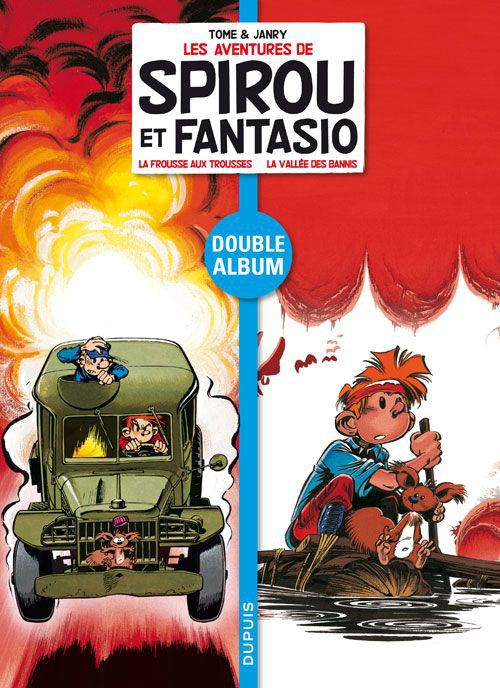
When Tome and Janry took over the series a couple of references to Gaston were made in La jeunesse de Spirou (Spirou's youth) where a scam artist is publishing a faux number five album of the Gaston series. And during the tale about Spirou's childhood Gaston's car is seen parked in front of the publishing company.
More recently a reference to Gaston was made in the album 'Au source du Z' (The source of Z) by Morvan and Munuera, when Spirou uses the time shifting machine he remarks that the experience is yucky, almost as bad as the Champagne that Gaston made out of fermented potatoes. Later in that album when Spirou has to use the time shifter once more he remarks that it's time to take a sip from Gaston's Champagne again.
Focus on Gaston
For a period, Franquin had trained his assistant Jidéhem to take over the strip in due time, but Jidéhem felt no affinity with the character and remained the background artist.[17] Franquin inversely grew tired of Spirou et Fantasio (a series he had not created himself, but inherited from Joseph 'Jijé' Gillain in 1946) and decided in 1968 to resign the job, and concentrate on the increasingly popular Gaston.[18] Gaston's antics appeared in Spirou from 1957 to 1996, a few months before Franquin's death in 1997, although new material appeared only sporadically after the early 1980s.[19]
Format and appeal
Gaston Lagaffe follows the classic 'gag' format of Franco-Belgian comics: one-page stories (initially half-a-page) with an often visual punchline, sometimes foreshadowed in the dialogue. The humour mixes slapstick, puns and running gags. Franquin's style is characterised by extremely nervous characters and action and very quotable dialogue. The series is much loved not only for its perfectly timed comedy, but also for its warm outlook on everyday life. Although Gaston works at Spirou magazine and one of his colleagues is a cartoonist, the series satirises office life in general rather than the publishing or comics business; Franquin himself worked at home.In the later episodes, the reader could discover a visual reference to the story in Franquin's signature at the bottom of the page.
Characters
Gaston Lagaffe
Gaston was hired - somewhat mysteriously - as an office junior at the offices of the Journal de Spirou (the real-life publication in which the strip appeared), having wandered in cluelessly. The strip usually focuses on his efforts to avoid doing any work, and indulge instead in hobbies or naps while all around him panic over deadlines, lost mail and contracts. Initially, Gaston was an irritating simpleton, but he developed a genial personality and sense of humour. Common sense however always eludes him, and he has an almost supernatural ability to cause disasters ('gaffes') to which he reacts with his catchphrase: 'M'enfin!' ('What the..?'). His job involves chiefly dealing with readers' mail. The ever-growing piles of unanswered letters ('courrier en retard') and the attempts of Fantasio and Léon Prunelle to make him deal with it or to retrieve documentation are recurring themes of the comic.
Gaston's age is a mystery - Franquin himself confessed that he neither knew nor indeed wanted to know it. Although Gaston has a job, a car and his own place, he often acts like a young teenager. In the publication of Dossier Franquin Franquin had said that Gaston is a boy in his late teens but certainly not in his twenties. He is invariably dressed in a tight polo-necked green jumper and blue-jeans, and worn-out espadrilles. It is said that his appearance was originally based on that of Yvan Delporte, editor of the Journal de Spirou at that time. Also, in his first gags, Gaston was an avid cigarette smoker, but his habit was slowly phased out.
Gaston alternates between phases of extreme laziness, when it is near impossible to wake him up, and hyper-activity, when he creates various machines or plays with office furniture. Over the years, he has experimented with cooking, rocket science, music, electronics, decorating, telecommunication, chemistry and many other hobbies, all with uniformly catastrophic results. His Peter Pan-like refusal to grow up and care about his work makes him very endearing, while ironically his antics account for half the stress experienced by his unfortunate co-workers.
Gaston's disregard for authority or even public safety are not confined to his office — they occasionally threaten the entire city. He is not above covering road signs with advertising posters or even snowmen, reasoning that it is the only decent use that they have — being oblivious to the chaos and accidents that covering the road signs cause.
Gaston's pets
Gaston is very fond of animals (as was Franquin of drawing them) and keeps several pets. The main ones are a depressive, aggressive seagull and a hyperactive cat. Like Franquin's most famous animal creation, the Marsupilami, those two never acquired a name and are just referred to as the cat and the seagull. Gaston also sometimes keeps a mouse (Cheese), and a goldfish (Bubulle). The animals are sometimes Gaston's partners in crime, sometimes the victims of his clumsiness and sometimes the perpetrators of nefarious schemes. They are depicted more realistically than the pets in Spirou, in that we are not privy to their inner thoughts. The cat and seagull in particular can be fairly vicious, to the extent of forcing all employees and an unwilling De Mesmaeker to wear helmets, but never to Gaston himself. They often team up to obtain food. For example, in volume 14, the seagull distracts the fishmonger while the cat steals a fish, which they later eat together.[20]
The office co-workers
Fantasio of Spirou et Fantasio is the main supporting character and irritable straight man to Gaston in the early part of the series. Franquin acknowledged with regret that he had totally destroyed the original clown-like personality of the character by using him in this role. In Gaston, instead of having adventures and doing some reporting, Fantasio has an editorial role in the magazine and, as such, has the impossible task of trying to put Gaston to work. By the time the story Bravo les Brothers came out (which, while nominally a Spirou et Fantasio story, was effectively hijacked by Gaston), it was time for Fantasio to leave. When Fournier took over the Spirou et Fantasio series in 1970, Fantasio disappeared from Gaston.[21] At first he made the occasional guest appearance, even once returning in the office itself, his absence explained as being away in Champignac,[22] but otherwise faded out completely.
Spirou of Spirou et Fantasio was a fairly major supporting character in the comic's very early days, though his role was quickly reduced to occasional appearances. He was on generally friendly terms with Gaston, sometimes trying to mediate between him and Fantasio, usually without much success. Like Fantasio, he vanished entirely from the comic when Franquin stopped drawing Spirou et Fantasio.
Léon Prunelle, an editor at the Journal de Spirou. Prunelle is even more short-tempered than Fantasio, from whom he has inherited not only the mammoth task of making Gaston work, but also the job of signing contracts with important businessman Aimé De Mesmaeker (see below). Initially optimistic about this, Prunelle slowly realizes that he cannot win. However he refuses to give up and sometimes resorts to drastic measures, such as locking up Gaston in the cellar or even a cupboard. Perpetually at the end of his tether, running around barking orders, Prunelle turns a nasty reddish purple when disaster strikes and utters his trademark outburst 'Rogntudju!' (a mangled version of 'Nom de Dieu', roughly the equivalent of 'bloody hell', then unacceptable in a children's comic). Occasionally, he manages to turn the tables on Gaston and shows that he is not without a sense of humour. He has black hair, a short beard and wears glasses.
Yves Lebrac, (first presented with the name Yvon Lebrac),[23] an in-house cartoonist, is comparatively laid-back. He is fond of puns and we see him woo (and eventually win) one of the attractive secretary girls over the course of the series. Although mostly on good terms with Gaston (unlike Prunelle), he occasionally loses his temper when deadlines loom and Gaston's interference becomes too much. When not a victim of 'gaffes', he is a lenient comrade of Gaston, and the character with which Franquin himself most identified.[24]
Joseph Boulier, a surly accountant for Éditions Dupuis, the publishers of the magazine. He states that he will not rest until he has tracked down every useless expense in the company, and in particular those of Gaston. However, his attempts to cause Gaston grief backfire in spectacular ways. He represents the more serious side of the comics publishing business.
Mademoiselle Jeanne ('M'oiselle Jeanne' to Gaston), a redheaded with freckles, is one of Gaston’s colleagues and his love interest. She was first depicted as comically unattractive in a gag where Gaston needs a partner for the back end of his pantomime horse costume, and chooses Jeanne because of her ponytail. Gradually however, she became cuter with her body turning from pear-shaped to curvaceous — if never really a beauty queen. Jeanne is a perfect match for Gaston, as she admires his talent, his courage, his inventiveness and is utterly oblivious to his lack of common sense — of which she herself has fairly little. However their courtship is perpetually stuck at the very first step. They address each other with the formal vous and as 'Mister' and 'Miss' and see each other mainly at the office — though they have had the occasional outing together. This platonic relationship, in a way, is in keeping with Gaston's refusal or inability to grow up. It is revealed in the album En direct de la gaffe that Jeanne is color blind: she can't tell green from red. She also still lives with her mother and, although it is assumed that she is well beyond her teens, is shown grounded after a row.
By the end of the series, Gaston's daydreams about Jeanne did become relatively more explicit. To the dismay of critics, Franquin once actually drew them naked, with Gaston in a state of arousal, on a commercially unavailable greeting card.[25]
Monsieur Dupuis (the real-life publisher Jean Dupuis) himself has made two appearances - both times we only see his legs.

Spirou is also staffed by the Van Schrijfboek brothers: the mustached translator Bertje and the red-haired editor Jef,[26] cleaning lady Mélanie Molaire (who always fumes at the mess left by Gaston and which she has to clean up), concierge Jules Soutier, and a string of attractive secretaries named Sonia (who is constantly handing in her notice), Yvonne and Suzanne. Occasionally, real-life figures from the Journal de Spirou (such as editor Yvan Delporte or writer Raoul Cauvin) have cameos.
Friends
Jules-de-chez-Smith-en-face (Jules-from-Smith’s-across-the-street) is one of Gaston’s friends. He 'works' (much in the same way as Gaston 'works') in the office just across the street from the Journal de Spirou, prompting countless attempts at cross-street communication via walkie-talkie, flash card, carrier seagull etc. Jules shares Gaston's childish enthusiasm, and is his sidekick in many ventures. Although they are close, Jules addresses Gaston as 'Lagaffe'.
Bertrand Labévue is another of Gaston’s friends/sidekicks and also his cousin. As his name indicates, (bévue means 'blunder'), he shares his cousin's tendency to goof up. Bertrand suffers from acute depression, mirroring Franquin's own problems with the illness, and Gaston and Jules do their best to cheer him up with food, country drives and other things (all of which backfire comically).
Manu is another friend, who regularly turns up in different jobs (à la Bert in Mary Poppins): chimney sweep, sewer worker, installer of street signage.. He also partakes in Gaston's schemes to irritate Longtarin, the policeman.
Foes
Aimé De Mesmaeker is a rich businessman; we know that he owns a private jet (until Gaston destroys it) and that his oldest daughter drives an Alfa Romeo.[27] His precise line of business is unknown, but he is repeatedly lured into the offices of Spirou by Fantasio or Prunelle in order to sign some lucrative contracts (see below). De Mesmaeker has developed a deep loathing for Gaston and by extension his colleagues. His frequent visits allow Franquin to satirise business rituals, as Dupuis's employees shower him with attention, complimentary drinks, cigars but De Mesmaeker almost inevitably ends up storming out of the offices, swearing never to set foot in them again, passed out on the floor or even in hospital due to Gaston's catastrophic blunders.
De Mesmaeker is named after Jean De Mesmaeker (known as Jidéhem from the French pronunciation of his initials J.D.M.), Franquin’s collaborator on the series; he remarked that the character looked like his own father.[28] The real-life Mr De Mesmaeker Sr — actually a salesman — soon found that, as Gaston's strip became increasingly popular, concluding a deal would result in the client asking, 'Where are the contracts?' (a recurring catchphrase in the comics).
Joseph Longtarin ('long nose') is a policeman working in the neighbourhood where the offices of Spirou are located. One of his particular responsibilities is for traffic and illegal parking. An exceptionally petty and vengeful man, he is the closest thing the series has to a villain. He is one of Gaston's favorite 'victims' as well as his nemesis. The two clash continually over Gaston's car and parking habits. Gaston retaliates for Longtarin's repeated attempts to ticket him by wreaking havoc on the neighbourhood's parking meters (not just a bugbear of Gaston, but of André Franquin too). He pulls off other pranks, such as putting a small effigy of Longtarin on the front of his car, in a parody of the Rolls-Royce Spirit of Ecstasy.[29]
Ducran & Lapoigne (“Courage & Stronghold”) is an engineering firm (specializing in steel bridges) whose offices neighbour those of Dupuis. This company is also a frequent victim of Lagaffe's mishaps and Fantasio or Prunelle often bear the brunt of Ducran and Lapoigne's anger—both of them being big muscular men, as their names suggest.
Freddy-les-doigts-de-fée ('fairy-fingered Freddy') is a burglar. His occasional break-ins at Spirou are always foiled accidentally by Gaston, who tends to inadvertently leave dangerous objects, devices or pets around the office. Workers at Spirou see Freddy as a fellow victim of Gaston, and, instead of turning him in to the police, offer him comfort and freebies when they find him in the morning.
Props, inventions and other running gags
Objects play an important part in Gaston's life, and some of them have become iconic enough to be sometimes recreated in real life for exhibitions and such. The main two are:
Gaston's car
Gaston drives an old Fiat 509, which he acquires in gag #321, decorated with racing patterns that he added himself.[30] However its top speed still allows passengers to safely pick flowers on motorway verges.[31] Much humour derives from the car's extreme state of decrepitude; for example, a friend of Gaston is able to 'waterski' behind it on a slick of oil, while Gaston strenuously denies any such leaks. The car also produces huge quantities of (often toxic) smoke, even more so when Gaston converts it to run on coal. Customisations and ill-fitted upgrades include:
- An emissions filter fitted to the exhaust pipe which turns out not to let anything through, causing the exhaust to come in the front.[32]
- A bag in which exhaust fumes are collected. Unfortunately, Gaston thoughtlessly empties the bag in a busy street, rendering everyone unconscious.[33]
- Snow chains.[34]
- A snow-plough device that sucks the snow into a heater, which, instead of evaporating the snow, fills the passenger compartment, freezing the occupants.[35]
- Seatbelts, which, accidentally wrap around the rear axle.[36]
- An airbag which smothers the driver (Prunelle claims it allows a less messy death in case of accident).
- A wind turbine that peels apart the car's roof, flying away with Prunelle dangling underneath.[37]
The car is inadvertently rocket-powered on two separate occasions.
Some of Gaston's colleagues are terrified at the very thought of sitting in the Fiat – Prunelle swears on several occasions that he will never set foot in it again. The car is also the source of many clashes with Longtarin, as Gaston endlessly devises schemes to avoid paying parking meters, even going as far as parking it up in a tree or faking roadworks.
The Gaffophone
This extraordinary instrument, a prehistoric-looking combination of horn and harp created by Gaston,[38][39] produces a sound so terrible and loud that it causes physical destruction all around and panics animals and even fighter jet pilots. Like the voice of the bard Cacofonix in Asterix, it horrifies everyone except its originator. The first time the instrument appears, the plucking of just one string causes the floor to collapse.[38] Gaston has also created at least one other instrument in the same vein, and an electric version of the Gaffophone.[40] Fantasio has tried several times to get rid of the Gaffophone, without success.
An illustrated text published in the Journal de Spirou column En direct de la Rédaction (and later collected in Gaston nº 10), chronicled (from the viewpoint of Prunelle) the Gaffophone's blossoming and development into a small ecosystem, which then self-destructed. Gaston later rebuilt his instrument.
Costumes
Fantasio Spirou Pdf
An early running gag involved Gaston coming up with elaborate and extremely impractical costumes for fancy dress parties at the facetious suggestions of his colleagues: Roly-poly toy, octopus, Greek urn, petrol pump, Eiffel Tower etc. He was invariably worried about whether he would be able to dance with the outfit on. Once, he dressed as the Marsupilami.[41]
Other inventions
These have included:
- A necktie- / shoelace-tying device
- A ceiling-suspended table[42]
- A self-heating duffle coat[43]
- A rotating Christmas tree[44]
- A pneumatic ashtray
- An electric scarecrow[45]
- A folding bicycle[46]
- A remote-controlled electric iron[47]
- A mini-lawnmower (to mow around daisies)
- A suit of armour for mice[48]
- A solar-powered flashlight[49]
- An electric cigar cutter, shaped like a guillotine which almost worked like a guillotine for the users' fingers.
- An automatic hammer. The inevitable 'gaffe' being that you first had to nail it to the wall.
- A seatbelt made of rubber, for easy access to the mailbox from the car.
- A coffeemaker which produces so stiff a drink, it renders the drinker (Gaston himself and De Mesmaeker) hyperenergetic, agitated and utterly unable to use even a pen without destroying it.
- A tanning umbrella, to tan (or sunburn) when it is raining
- A perpetual motion machine.
The mail backlog
The task most often given to Gaston by Prunelle is to sort and answer the mail, presumably sent by readers. This often builds up to a mountain-like backlog, which Gaston often attempts to dispose of in creative ways, for instance stuffing a homemade sofa with it. In a similar vein, Gaston was briefly put in charge of the reference library: at first he arranged the books into a maze and charged his colleagues for admission, and later he simply piled them up, dug a cave in the middle and settled there with his pets, a radio and a stove to sleep all day.
De Mesmaeker's contracts
This is possibly the most frequent running gag in the series, and by Franquin's admission a MacGuffin: 'Whatever's in the contracts is irrelevant. What we want to see is how Gaston will prevent them from being signed.'
Aimé De Mesmaeker is a hot-tempered businessman who often visits the office (which he increasingly, and with some justification, sees as a madhouse) in order to sign some important contracts. However, the contracts are irrevocably jinxed: before De Mesmaeker can apply pen to paper, Gaston's latest gimmick comes along, provokes mayhem and causes the hapless businessman to storm out, rip the contracts up, or in some cases pass out. Even when they do get signed, Gaston can always be counted on to accidentally destroy them.
Over the years, Fantasio and Prunelle's efforts to get the iconic contracts signed become increasingly frantic and desperate. Prunelle even goes so far as to send Lagaffe to the other side of town on some wild goose chase or bound and gag him and lock him into a cupboard but even these drastic measures backfire and fail.
On two occasions, De Mesmaeker actually ended up signing other contracts with Gaston spontaneously, instead of the contracts, both merchandising deals over Gaston's inventions (the 'Cosmo-clock', an Apollo spacecraft-shaped cuckoo clock,[50] and a soup recipe).
Politics, activism and promotional material
Authors at Spirou could only go so far in expressing anything resembling politics within the magazine, and so the author of Gaston generally stuck to a gentle satire of productivity and authority. However, the pacifism and concern for the environment that formed the basis of Franquin's politics and would be expressed much more bluntly in Idées noires were already surfacing in Gaston (and Spirou et Fantasio). Very occasionally, Franquin stepped over the mark, as in an uncharacteristically angry strip where Gaston uses a toy Messerschmitt plane to strafe the whole office in protest at their (real life) appearance in the magazine's modelling column (while building the model, he says: “… and now, the swastikas. They are very popular amongst retards”). Outside of Spirou however, Franquin had a free rein, and used Gaston in promotional material for diverse organisations such as Greenpeace and Amnesty International. In the former, activists scare whales away from whalers by plucking the dreaded gaffophone. For the latter, Franquin produced a gut-wrenching sequence where Gaston is beaten and tortured and forced to watch M'oiselle Jeanne raped in front of him, before being sent to a prison camp. In the penultimate frame he faces capital punishment which the punters hope 'serves as an example'. Awaking in a sweat, Gaston shouts at the reader that 'although this was a nightmare, it's happening right now around the world', urging membership.
Gaston has also appeared in advertising campaigns for batteries, a soft drink (Orange Piedboeuf),[51] and in a campaign to promote bus use. The material was always drawn by Franquin himself rather than under licence, and has been reprinted in books. The latter campaign is interesting in that it shows Franquin's evolution from car enthusiast inventing the Turbo-traction and other fancy sports vehicles for Spirou in the 1950s, to disillusioned citizen concerned over traffic and pollution in later years. One topical strip had the seagull boycotting Gaston's car after seeing a bird stuck in an oil spill on television. 'Life is becoming more and more complicated', its owner concludes gloomily in a very rare joke-free ending.
Albums
In 1960 the first Gaston book, a small-format (7x13 cm) publication, was released. Its format was so unorthodox that some retailers thought it was a promotional issue to be given away for free.[52] The cover features Gaston wearing orange espadrilles without socks, not yet given his trademark blue espadrilles. Fifteen major albums were published between 1963 and 1996, including all the strips that appeared in Spirou. There were some oddities such as number 1 appearing out of sequence and number 0 twenty years later. The first five were quickly sold out; the others were frequently reprinted.
Included in the series were the 'R1' through 'R5' albums (R for Réédition, French for republication). The R5 album was not published until 1986; its non-existence until then had been a mystery. This was due to the republication of the real first five books: they were published on a smaller format and from this small ones they couldn't make five big ones. After several years it was decided to fill it up with early unpublished material and some advertising gags for PiedBœuf.
Beginning in 1987, Éditions J'ai lu began publishing a 17-volume series in paperback format. The titles and contents did not exactly match the large-format albums.
In 1996, upon Gaston's 40th anniversary, Dupuis and Marsu Productions published Edition Définitive, containing nearly all Gaston gags in chronological order. As some of the earliest material had been damaged, restoration work was done by Studio Léonardo, with the results approved by Franquin.[53] This edition is being published in Spain by Planeta DeAgostini Comics starting in January 2007.[54]
In 2007, upon Gaston's 50th anniversary, Marsu Productions published Gaston 50, a new album with unpublished work. The strange number 50 refers to Gaston's age but also to the chaotic numbering of the Classic series, which hadn't got a number five for a very long time.
| n° | Title | Year[a] | Pages | Format | Content[b] | Period [a] | Authors |
|---|---|---|---|---|---|---|---|
| 0- | Gaston | 01960 | 19,7 x 8,3cm | new | 1960 | Franquin, Jidehem | |
| 02 | Gala de gaffes | 01963 | 64 | 22 x 15cm | new (strips 49 - 151) | 1962 | Franquin, Jidehem |
| 03 | Gaffes à gogo | 01964 | 64 | 22 x 15cm | new (strips 144 - 210) | 1964 | Franquin, Jidehem |
| 04 | Gaffes en gros | 01965 | 64 | 22 x 15cm | new (strips 215 - 286) | 1965 | Franquin, Jidehem |
| 01 | Gare aux gaffes | 01966 | 64 | 22 x 15cm | new (strips 294 - 351) | 1959 to 1966 | Franquin, Jidehem |
| 05 | Les gaffes d'un gars gonflé | 01967 | 64 | 22 x 15cm | new (strips 350 - 410) | 1967 | Franquin, Jidehem |
| 06 | Des gaffes et des dégâts | 01968 | 59 | 21,8 x 30cm | new (strips 413 - 480) | 1968 | Franquin |
| 07 | Un gaffeur sachant gaffer | 01969 | 59 | 21,8 x 30cm | new (strips 472 - 543) | 1969 | Franquin |
| 08 | Lagaffe nous gâte | 01970 | 59 | 21,8 x 30cm | new (strips 544 - 607) | 1970 | Franquin |
| 0R1 | Gala de gaffes à gogo | 01970 | 59 | 21,8 x 30cm | albums 2 and 3 | 1963 | Franquin, Jidehem |
| 09 | Le cas Lagaffe | 01971 | 52 | 21,8 x 30cm | new (strips 601 - 658) | 1971 | Franquin |
| 010 | Le géant de la gaffe | 01972 | 52 | 21,8 x 30cm | new (strips 659 - 714) | 1972 | Franquin |
| 0R2 | Le bureau des gaffes en gros | 01972 | 52 | 21,8 x 30cm | album 4 and unpublished | 1965 | Franquin, Jidehem |
| 0R3 | Gare aux gaffes du gars gonflé0 | 01973 | 52 | 21,8 x 30cm | album 1 and 5 | 1959 to 1966 | Franquin, Jidehem |
| 011 | Gaffes, bévues et boulettes | 01973 | 44 | 21,8 x 30cm | new (strips 715 - 849) | 1972 | Franquin |
| 0R4 | En direct de la gaffe | 01974 | 44 | 21,8 x 30cm | unpublished | 1960 to 1968 | Franquin, Delporte |
| 012 | Le gang des gaffeurs | 01974 | 44 | 21,8 x 30cm | new (strips 759 - 805) | 1974 | Franquin |
| 013 | Lagaffe mérite des baffes | 01979 | 46 | 21,8 x 30cm | new (strips 806 - 850) | 1975 to 1979 | Franquin |
| 014 | La saga des gaffes | 01982 | 44 | 21,8 x 30cm | new (strips 851 - 890) | 1980 to 1982 | Franquin |
| 00 | Gaffes et gadgets | 01985 | 46 | 21,8 x 30cm | unpublished | 1957 | Franquin, Delporte |
| 0R5 | Le lourd passé de Lagaffe | 01986 | 46 | 21,8 x 30cm | unpublished | 1957 to 1982 | Franquin, Jidehem |
| 015 | Gaffe à Lagaffe ! | 01996 | 45 | 21,8 x 30cm | new and unpublished | 1987 to 1996 | Franquin |
| 019 | Gaston 19 | 01999 | 44 | 21,8 x 30cm | new and unpublished | 1957 to 1997 | Franquin |
| 050 | Gaston 50 | 02007 | 44 | 21,8 x 30cm | new and unpublished | 1957 to 1997 | Franquin |
- [a] year the comics book was published in album, as opposed to the period during which the strips were published in Spirou magazine.
- [b] 'new' refers to an album whose strips had been published in magazine one or some years earlier (with the numero of the strips), while 'unpublished' means the album is a collection of unrelated strips never published in albums by mistake. 'album' means the album is a republication.
Other publications
- Biographie d'un gaffeur (1965) Franquin & Jidéhem, Gag de poche n°26
- La fantastica Fiat 509 di Gaston Lagaffe (1977)
- Gaston et le Marsupilami (1978, ISBN 2-8001-0637-9)
- Les Robinsons du rail (1981, ISBN 2-903403-05-8) An illustrated story album (not a comic) featuring Gaston, Spirou and Fantasio
- Fou du Bus (1987, ISBN 2-906452-01-7) Advert album commissioned by the Union of Public Transportations
- Rempile et désopile (1989) Advertising gags for Philips, only printed in 2500 editions
- Le facteur est mon ami (1992) Advertising for the Belgian Post
- Gaston 50 (2007, ISBN 2-35426-000-8) Edition for Gaston's 50th birthday with unpublished work
Tributes and pastiches
Issue no 3672 of Spirou magazine was conceived as a tribute to the series, with tributes and parodies being drawn by artists such as Yoann, Olivier Schwartz, Lewis Trondheim, Fabrice Tarrin etc.
In the Belgian Comic Strip Center in Brussels the permanent exhibition brings homage to the pioneers of Belgian comics, among them André Franquin. One of the rooms dedicated to his comics is a replica of Gaston's office.[55]
Gaston Lagaffe is among the many Belgian comics characters to jokingly have a Brussels street named after them. The Rue du Marché aux Herbes / Grasmarkt has a commemorative plaque with the name Rue Gaston Lagaffe / Guust Flaterstraat placed under the actual street sign. [56]
A statue of Gaston Laffe was erected in 1996 in the Boulevard Pachéco, Rue des Sables / Pachécolaan, Zandstraat in Brussels. [57]
Fairy Tail Tome 53
There is also a wall, part of the Brussels' Comic Book Route, designed in homage to the comics. The comic book wall was designed in 2007 in the Rue de l'Écuyer / Schildknaapstraat. [58]
Gaston film
In 1981, a live-actionFrench film based on Gaston Lagaffe, called Fais gaffe à la gaffe! directed by Paul Boujenah and starring Roger Mirmont was released to disappointing reception. It features future The Sopranos star Lorraine Bracco.
Franquin, uncomfortable with the prospect of the adaptation of Gaston, had given permission for the elements and jokes from his work to be used, but not the actual characters. As a result, the characters' names were all changed, making the film appear more like an imitation than a proper adaptation.
See also
Notes
Spirou Et Fantasio Tv Show
- ↑ gastonlagaffe.com. 'Dossiers-28 février 1957' (in French).
- ↑ Image of Spirou n°985 Gaston page
- ↑ gastonlagaffe.com. 'Franquin raconte Gaston' (in French).
- ↑ Plate1 of Spirou n°1000 cover
- ↑ Plate2 of Spirou n°1000 cover
- ↑ Gaston-Spirou n°1000 supplement Gaston gag n°1
- ↑ BDoubliées. 'Spirou année 1957' (in French).
- ↑ gastonlagaffe.com. 'Dossiers-28 novembre 1957' (in French).
- ↑ gastonlagaffe.com. 'Dossiers-5 décembre 1957' (in French).
- ↑ gastonlagaffe.com. 'les différentes époques' (in French).
- ↑ gastonlagaffe.com. 'Dossiers-19 septembre 1957' (in French).
- ↑ gastonlagaffe.com. 'Dossiers-21 novembre 1957' (in French).
- Collignon, Claude. 'Images moins connues dans SPIROU' (in French).
- Inigo Yanez, Pedro. 'Apparitions de Gaston Lagaffe' (in French).
- ↑ inedispirou.net
- ↑ peuleux.fr Spirou web site
- ↑ franquin.com. 'Franquin-les amis-Jidéhem' (in French).
- ↑ franquin.com. 'Franquin-une vie-1968' (in French).
- ↑ gastonlagaffe.com. 'Dossiers-inventaire-all Gaston index' (in French).
- ↑ Franquin, André(w).'Gag #726'Gastonv14,(1997),Dupuis
- ↑ Franquin, André(w).'Gag #481'Gastonv8,(1997),Dupuis
- ↑ Franquin, André(w).'Gag #512'Gastonv9,(1997),Dupuis
- ↑ LaGaffeMeGate.free.fr. 'Prenom-Yves Lebrac' (in French).
- ↑ Franquin.com. 'Personnages-Yves Lebrac' (in French).
- ↑ Thierry Groensteen, 'Bloc-Notes', Les Cahiers de la BD, March 1988, p67-68
- ↑ Unnamed in the comic book itself, known mainly as 'the redhead', Jef's identity is confirmed on the official website (in French): http://www.gastonlagaffe.com/saga/personnages/#jef
- ↑ Franquin, André(w).'Gag #587'Gastonv11,(1997),Dupuis
- ↑ franquin.com. 'Gaston-personnages-De Mesmaeker' (in French).
- ↑ Franquin, André(w).'Gag #786'Gastonv15,(1997),Dupuis
- ↑ Franquin, André(w).'Gag #327'Gastonv5,(1997),Dupuis
- ↑ Gaston nº 12
- ↑ Franquin, André(w).'Gag #447'Gastonv8,(1997),Dupuis
- ↑ Franquin, André(w).'Gag #448'Gastonv8,(1997),Dupuis
- ↑ Franquin, André(w).'Gag #550'Gastonv10,(1997),Dupuis
- ↑ Franquin, André(w).'Gag #551'Gastonv10,(1997),Dupuis
- ↑ Franquin, André(w).'Gag #664'Gastonv13,(1997),Dupuis
- ↑ Franquin, André(w).'Gag #863'Gastonv17,(1997),Dupuis
- Franquin, André(w).'Gag #449'Gastonv8,(1997),Dupuis
- ↑ Gaston nº 8
- ↑ Franquin, André(w).'Gag #600'Gastonv11,(1997),Dupuis
- ↑ Franquin, André(w).'Gag #601'Gastonv11,(1997),Dupuis
- ↑ Franquin, André(w).'Gag #338'Gastonv5,(1997),Dupuis
- ↑ Franquin, André(w).'Gag #380'Gastonv6,(1997),Dupuis
- ↑ Franquin, André(w).'Gag #385'Gastonv6,(1997),Dupuis
- ↑ Franquin, André(w).'Gag #535'Gastonv10,(1997),Dupuis
- ↑ Franquin, André(w).'Gag #629'Gastonv12,(1997),Dupuis
- ↑ Franquin, André(w).'Gag #899'Gastonv18,(1997),Marsu Productions
- ↑ Franquin, André(w).Gastonv18,(1997),Marsu Productions
- ↑ Franquin, André(w).'Gag #868'Gastonv17,(1997),Dupuis
- ↑ Franquin, André(w).'Gag #604'Gastonv11,(1997),Dupuis
- ↑ These strips were later collected in Le lourd passé de Lagaffe and Série définitive Gaston n°2. Piedboeuf is now part of Interbrew
- ↑ gastonlagaffe.com. 'Série classique Gaston 0' (in French).
- ↑ franquin.com. 'Albums-Edition Définitive' (in French).
- ↑ planetadeagostinicomics.com. 'Planeta DeAgostini Comics > Colección BD > Tomás, el gafe' (in Spanish).
- ↑ http://www.tento.be/sites/default/files/tijdschrift/pdf/OKV1992/Belgisch%20Centrum%20van%20het%20Beeldverhaal%20Brussel.pdf
- ↑ http://www.ebru.be/Other/Strips/bruxelles-1000-noms-de-rue-bd.html
- ↑ http://www.belgique-tourisme.fr/informations/attractions-touristiques-bruxelles-statue-gaston-lagaffe/fr/V/30982.html
- ↑ http://www.brussels.be/dwnld/79394421/gaston1.jpg
Sources
- Franquin publications in Le Journal de Spirou BDoubliées (French)
- Gaston appearances in Le Journal de Spirou gastonlagaffe.com (French)
- Sadoul, Numa; André Franquin (1986). Et Franquin créa la gaffe. Distri B.D. ISBN2-87178-000-5.
External links
- Gaston Lagaffe official site(French)
- Franquin official site(French)
- The Franquin forum(French)
Spirou Et Fantasio Tome 53 Pdf Writer Download
| Series |
|---|
| Spirou et Fantasio characters |
| Spirou and Fantasio albums |
| Gaston Lagaffe albums |
| Marsupilami albums |
| Other albums |
| Collaborators |
| Publishing houses |
| Magazines |